
May 20, 2026
The Policy Is Now Operational — and the Market Has Moved
The Inflation Reduction Act is no longer a future risk to model. It is an active structural force reshaping how biopharma assets are valued, how deals are structured, and which pipelines attract capital.
Medicare drug price negotiation is live. Negotiated prices for Eliquis, Jardiance, Xarelto, and seven other drugs took effect in 2026 as the first cohort of binding Medicare Part D agreements. A second negotiation wave is already underway. Every acquirer with a commercial-stage or late-clinical asset in its sights is now running a fundamentally different set of numbers than they were three years ago.
The companies that adapted early are seeing it in their deal outcomes. The ones still applying pre-IRA valuation frameworks to post-IRA assets are carrying material risk they may not fully recognize yet.
How the IRA Reshapes Asset Valuation in M&A
The standard pre-IRA DCF model for a commercial-stage asset assumed relatively stable net pricing through the exclusivity period, with erosion beginning at LOE. That assumption no longer holds for assets that qualify for Medicare negotiation.
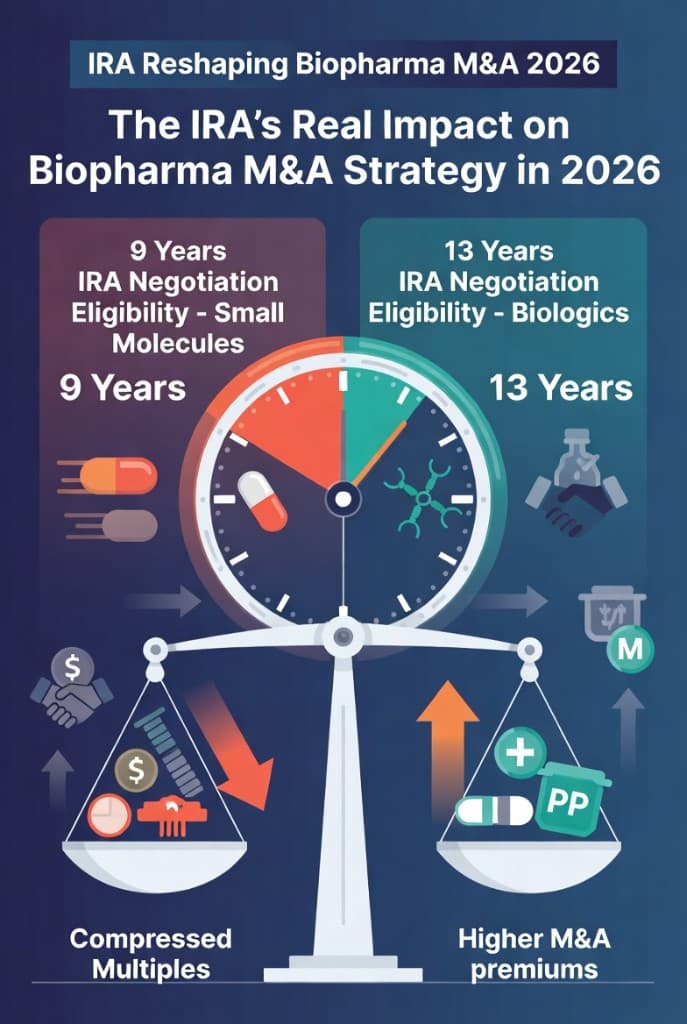
The negotiation trigger compresses the effective exclusivity window. Small molecule drugs become eligible for negotiation nine years after FDA approval; biologics at thirteen years. For an asset approved today, that is not a distant hypothetical — it is a hard date that belongs in the deal model. Acquirers are explicitly discounting peak sales projections for any asset that hits the nine-year threshold within the deal's expected value-capture window.
The practical implication is direct: a small molecule with six years of post-approval commercial life remaining is worth materially less than it was under prior assumptions. The acquirer's ability to sustain Medicare pricing is capped in a way it simply was not before. That repricing is already visible in bid-ask spreads and in the deal structures being negotiated right now.
The Small Molecule Problem Is Bigger Than It Looks
Small molecules are the most directly exposed asset class under the IRA's current framework. The nine-year negotiation clock is four years shorter than the window for biologics, and small molecules dominate both the first and second negotiation cohorts.
This is not purely a pricing issue. It is a pipeline prioritization issue. Several large-cap acquirers have publicly shifted R&D and BD&L focus toward biologics, gene therapies, and other modalities that carry the longer exclusivity window or are structurally less exposed to negotiation. The logic is straightforward: if two assets have comparable clinical profiles but one faces negotiation at year nine and the other at year thirteen, the NPV difference is large enough to determine which one gets acquired.
For sellers of small molecule assets, the window to act is narrowing. The closer an asset gets to its negotiation eligibility date, the more aggressively buyers discount. Transactions that might have closed at a given multiple two years ago are now closing lower — or not closing at all — because the buyer's model no longer supports the seller's floor price. Understanding exactly where your asset sits on that timeline is not optional. It is the starting point for any credible transaction process.
For a broader view of how patent timelines and LOE dynamics are intersecting with deal activity this year, the analysis in 2026 biopharma M&A trends and strategies under patent challenges is worth reading alongside this piece.
Biologics Get More Runway, But Not Forever
The thirteen-year negotiation window for biologics is not immunity. It is a delay. And the market is pricing that delay with more precision than it did when the IRA first passed.
Biologics with strong clinical differentiation and limited biosimilar competition still command premium multiples. But the IRA has introduced a ceiling on long-term pricing assumptions that did not exist before, and acquirers are modeling it explicitly. A biologic approved in 2020 hits negotiation eligibility in 2033 — well within the value-capture horizon of most strategic acquisitions being executed today.
The biosimilar dynamic compounds the pressure. A biologic facing both negotiation eligibility and meaningful biosimilar entry in the same five-year window is a double compression event, and buyers are stress-testing exactly that scenario in diligence. Humira's post-biosimilar trajectory is the reference case every BD team is citing internally. The question for any biologic acquisition in 2026 is not whether the asset is good — it is whether the pricing durability justifies the multiple being asked.
Pipeline Prioritization Is Now a Negotiating Variable
One underappreciated effect of the IRA is how it has changed what acquirers will pay for pipeline depth in specific therapeutic areas.
Oncology assets, historically among the most valued in any deal, now face closer scrutiny. Many oncology drugs are small molecules with established commercial trajectories that place them squarely in the early negotiation cohorts. A Phase III oncology asset approved in 2027 and reaching peak sales by 2031 faces negotiation eligibility by 2036 — well within the buyer's expected hold period.
Rare disease and orphan drug assets are attracting disproportionate interest because their patient populations are too small to generate the Medicare expenditure thresholds that trigger negotiation. Acquirers are explicitly factoring negotiation-exemption status into pipeline prioritization, and it is showing up in deal premiums. Rare disease M&A multiples in 2026 are running materially above the broader biopharma average, and the IRA's structural logic is a significant driver.
This shift also intersects directly with the patent cliff dynamics driving a large share of M&A activity this year. The patent cliff pressures facing growth-stage biopharma CEOs are now inseparable from IRA exposure analysis — both compress the effective revenue window for the same assets.
Where Acquirers Are Actually Looking in 2026
The IRA has not stopped M&A activity. It has redirected it. Deal flow in 2026 reflects a clear set of preferences that map directly to IRA exposure management.
Modality diversification is driving a measurable share of large-cap deal activity. Companies with portfolios heavily weighted toward small molecules are acquiring biologic, cell therapy, and gene therapy assets to rebalance their long-term revenue mix. This is IRA exposure management expressed through the deal pipeline — not purely scientific strategy.
Bolt-on acquisitions in negotiation-exempt categories are running at elevated frequency. Rare disease, pediatric indications, and certain orphan designations carry structural protection from the negotiation mechanism, and acquirers are paying for that protection. The premium is real and it is rational.
Earlier-stage assets are drawing more attention from strategic buyers who want to control the development pathway and shape the commercial profile in ways that affect negotiation eligibility. A Phase II asset gives the acquirer more optionality than a Phase III asset already on a fixed regulatory and commercial trajectory. That optionality has a price, and buyers are paying it.
The role of data and AI in identifying these opportunities faster than the competition is covered in detail in AI in biopharma M&A — the speed advantage in deal sourcing is compressing timelines in ways that make point-in-time analysis structurally insufficient.
The Execution Gap Is Where Deals Break Down
Understanding the IRA's structural impact on valuation is necessary. Executing on that understanding in a live transaction is where most companies fall short.
The problem is not analytical. Most BD teams can model the negotiation timeline and discount accordingly. The harder problem is that IRA-adjusted deal structures require different negotiating positions, different earn-out constructions, and different risk-sharing mechanisms than the frameworks most teams have used for the past decade. Milestone structures that made sense before the IRA may now misalign incentives when both parties know the asset's pricing trajectory is capped at a specific point.
Sellers who do not account for IRA exposure in their own valuation ask are either leaving money on the table or killing deals unnecessarily. A seller who prices an asset as if the IRA does not exist will face a buyer who prices it as if it does. That gap does not close through negotiation — it closes through one party adjusting their model. Better to understand the buyer's framework before entering the process than to discover the disconnect at the term sheet stage.
This is where 35 years of hands-on operator experience in executing strategic transactions matters. The advisory work at Katogen is built on having sat on both sides of these negotiations — as a buyer completing 17 acquisitions and as an operator who understands what drives value in the assets being transacted. The IRA has changed the inputs; the discipline of rigorous, implication-aware deal structuring has not.
The speed at which these dynamics are evolving also matters. As the analysis in the evolution of biopharma strategy makes clear, the window between when market conditions shift and when they are fully priced into deal terms is compressing. Companies still running quarterly strategic reviews are operating on intelligence that is already stale by the time it reaches the people who need to act on it.
FAQs
What is the IRA's direct impact on biopharma M&A valuations in 2026?
The IRA's Medicare drug price negotiation mechanism has introduced a hard ceiling on long-term pricing assumptions for commercial-stage assets. Small molecules face negotiation eligibility nine years post-approval, biologics at thirteen years. Acquirers are now explicitly discounting peak sales projections for assets that hit those thresholds within the deal's value-capture window, compressing multiples for affected asset classes.
Which asset types are most exposed to IRA-driven valuation pressure?
Small molecules are the most directly exposed, given the shorter nine-year negotiation clock and their concentration in the first and second Medicare negotiation cohorts. Commercial-stage oncology assets with established revenue trajectories are under particular scrutiny. Rare disease, orphan drug, and pediatric assets carry structural negotiation exemptions and are attracting higher premiums as a result.
Are biologics protected from IRA price negotiation?
Biologics have a longer thirteen-year window before negotiation eligibility, but they are not exempt. Any biologic approved today faces negotiation eligibility in 2039. Acquirers are modeling that date into deal structures, and assets facing both negotiation eligibility and biosimilar entry in the same window face compounded pricing pressure.
How is the IRA changing deal structure, not just valuation?
Beyond headline multiples, the IRA is affecting earn-out construction, milestone design, and risk-sharing mechanisms. Standard milestone structures built around peak sales assumptions may misalign incentives when both parties know pricing is capped at a specific point. Deals are increasingly incorporating negotiation-adjusted revenue floors and modified royalty structures to bridge the gap between seller and buyer models.
Why are rare disease assets commanding higher M&A premiums in 2026?
Rare disease and orphan drug assets typically serve patient populations too small to generate the Medicare expenditure thresholds that trigger IRA negotiation eligibility. That structural protection from pricing compression is a material valuation advantage, and acquirers are explicitly paying for it. The premium reflects rational IRA exposure management, not purely scientific preference.
How should a seller prepare for IRA-adjusted buyer diligence?
Sellers need to run the buyer's model before entering the process. That means calculating the asset's negotiation eligibility date, stress-testing revenue projections under negotiated pricing scenarios, and identifying any structural features — orphan designation, rare disease status, modality — that affect exposure. A seller who enters negotiations without this analysis will face a buyer who has already done it.
Does the IRA affect early-stage pipeline acquisitions the same way it affects commercial-stage deals?
The direct impact is lower for early-stage assets because the negotiation timeline is further out and the commercial profile is not yet fixed. That is part of why strategic buyers are showing increased interest in Phase II assets — earlier entry gives the acquirer more optionality to shape the development and commercial pathway. The IRA has effectively increased the option value of earlier-stage transactions relative to late-stage or commercial deals.
The IRA has not made biopharma M&A harder. It has made imprecision more expensive. The companies executing well in 2026 built the IRA's structural logic into their deal frameworks early, adjusted their asset preferences accordingly, and are negotiating from analytical clarity rather than outdated assumptions. The window to build that clarity — before it is fully priced into every deal you are competing for — is narrowing.
For operator-led biopharma consulting on these topics, see our biopharma consulting services hub or contact Katogen.
